Data Center

A collection of research, regulations, resources, and reports from the Never Okay Project

Type a keyword here

Guide

30

min read

Guide to Building Support Groups for Survivors of Sexual Harassment in the Workplace

For the past four years, Indonesia has ranked among the five worst countries in the world for working conditions. This is due to the ongoing neglect of workers' rights, unfair labor practices, and violence against workers (ITUC Global Rights Index). This includes tangible instances of sexual harassment that have long been occurring. Sexual harassment in the workplace, which is a form of sexual violence, is akin to an iceberg phenomenon that only sees its tip.

Of the 80% of Indonesian women who have experienced sexual harassment at work, only 1% dare to report it (Better Work Indonesia, 2015). In another study from 2013, three out of ten female construction workers reported experiencing frequent sexual harassment, even daily (Hegewisch and O’Frarrell, 2015).

Regarding work relations, cases of sexual harassment in the workplace can indeed be vertical (the relationship between workers and supervisors) or horizontal (the relationship between workers and fellow workers). Various forms of sexual harassment, sexual violence, and discrimination in the workplace are rooted in power imbalances, in terms of gender, position and employment status, as well as economic conditions and resource ownership.

Based on the survey results of the Portrait of Sexual Harassment Conditions in Indonesian Companies by the Never Okay Project and Indonesia Business Coalition for Women Empowerment (2019), 82% of female respondents reported having experienced sexual harassment in the workplace in the past three years. Meanwhile, 18% of male respondents reported having experienced sexual harassment in the workplace in the past three years. Despite the significant disparity in comparison, this finding debunks the myth that sexual harassment only occurs against women. The higher vulnerability of female workers does not eliminate the possibility that harassment also occurs against male workers.

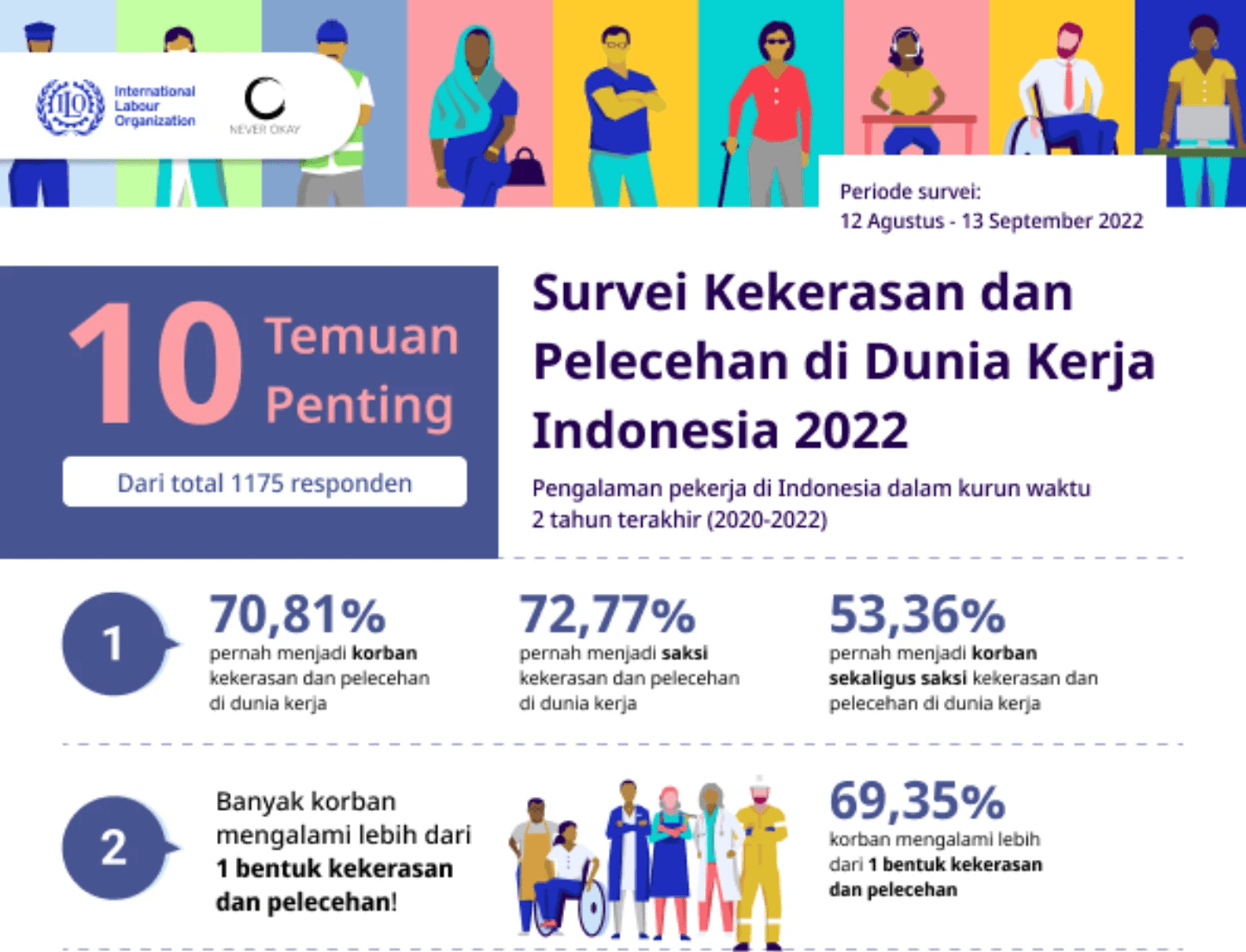
According to a survey conducted by the Never Okay Project and the International Labour Organization in 2022, victims of violence and harassment in the workplace experience various negative impacts both professionally and personally. 47% of victims want to leave their jobs, 41.35% avoid certain work situations, 22.96% experience a decline in work performance and evaluations, and 9.74% never want to work again. Victims also suffer physical health issues (headaches, insomnia, pain) and mental health issues (anger, shame, fear, anxiety, stress, depression). Even 12.86% of victims have considered ending their lives.

In this condition, victims become powerless and desperate because they feel that there is no one who can help them. Victims of sexual harassment need others to be a channel for sharing their experiences. This is where the role of support organizations becomes very important in the recovery process of victims of violence and sexual harassment. Given the ongoing lack of commitment to addressing cases of sexual harassment in the workplace, the Never Okay Project presents an intervention strategy in the form of a guideline for establishing support groups that can be used by employers to demonstrate their support for survivors.

According to the definition by Marge Piercy and Jane Freeman, a support group is a therapy group where each member discusses their own experiences and problems and provides understanding and attention to one another with the aim of building self-confidence in every member.

This booklet is designed to provide information and guidance for building and organizing activities for Support Groups for Survivors/Victims of Sexual Harassment in the Workplace. The existence of support groups will provide emotional assistance to members, especially to survivors of sexual harassment. The presence of support groups in the workplace is expected to contribute positively to the recovery process from trauma faced, by fostering a new belief that there are still others who believe in and are willing to provide support.

Read more

Research

30

min read

Everyone Can Be Affected: Report on the Results of the Survey on Violence and Harassment in the Indonesian Workplace 2022

Violence and harassment in the workplace, including gender-based violence, is a serious issue. The presence of violence and harassment can have adverse effects on the business world, companies, and workers, affecting relationships in the workplace, the health and well-being of workers, company productivity, and the reputation of the company.

One of the challenges in efforts to end violence and harassment in the workplace in Indonesia is the lack of public awareness regarding this issue, including the ability to identify forms of violence and harassment, as well as how to respond to them. Often likened to an iceberg phenomenon, many victims of violence and harassment in the workplace are reluctant to report their cases.

In June 2019, the International Labor Conference in Geneva, representing elements of government, employers, and trade unions from its member countries; adopted ILO Convention No. 190 (C190) on the Elimination of Violence and Harassment in the World of Work. This is the first international agreement that recognizes everyone's right to a world of work free from violence and harassment, including gender-based violence and harassment.

C190 is an important instrument developed by the world of work (representatives of the government, employers, and workers), and establishes a clear and common framework for preventing and addressing violence and harassment, based on an inclusive, integrated, and gender-responsive approach.

The limited information on data, research, and case analysis reports in Indonesia discussing violence and harassment in the workplace in Indonesia (especially forms of violence and harassment other than sexual violence and harassment) is also one of the obstacles. However, the availability of relevant data is crucial to remind us of the urgency of this issue, including serving as a basis for the formulation of prevention and case handling programs.

Through the 2022 Indonesia Violence and Harassment Survey in the World of Work, the ILO Jakarta Office and the Never Okay Project attempt to map workers' experiences in Indonesia related to violence and harassment in the workplace, both as victims and witnesses over the past two years (2020-2022). In addition to filling data gaps, this survey report also provides an opportunity to raise awareness of the roles and involvement of various parties and stakeholders. In this regard, the ratification of ILO Convention 190 on the “Elimination of Violence and Harassment in the World of Work” can support the Law on Sexual Violence Crime No. 12/2002 and demonstrate a more serious commitment to providing protection to Indonesian workers from violence and harassment in the workplace.

Read more

MUST READ

Results of the 2022 survey

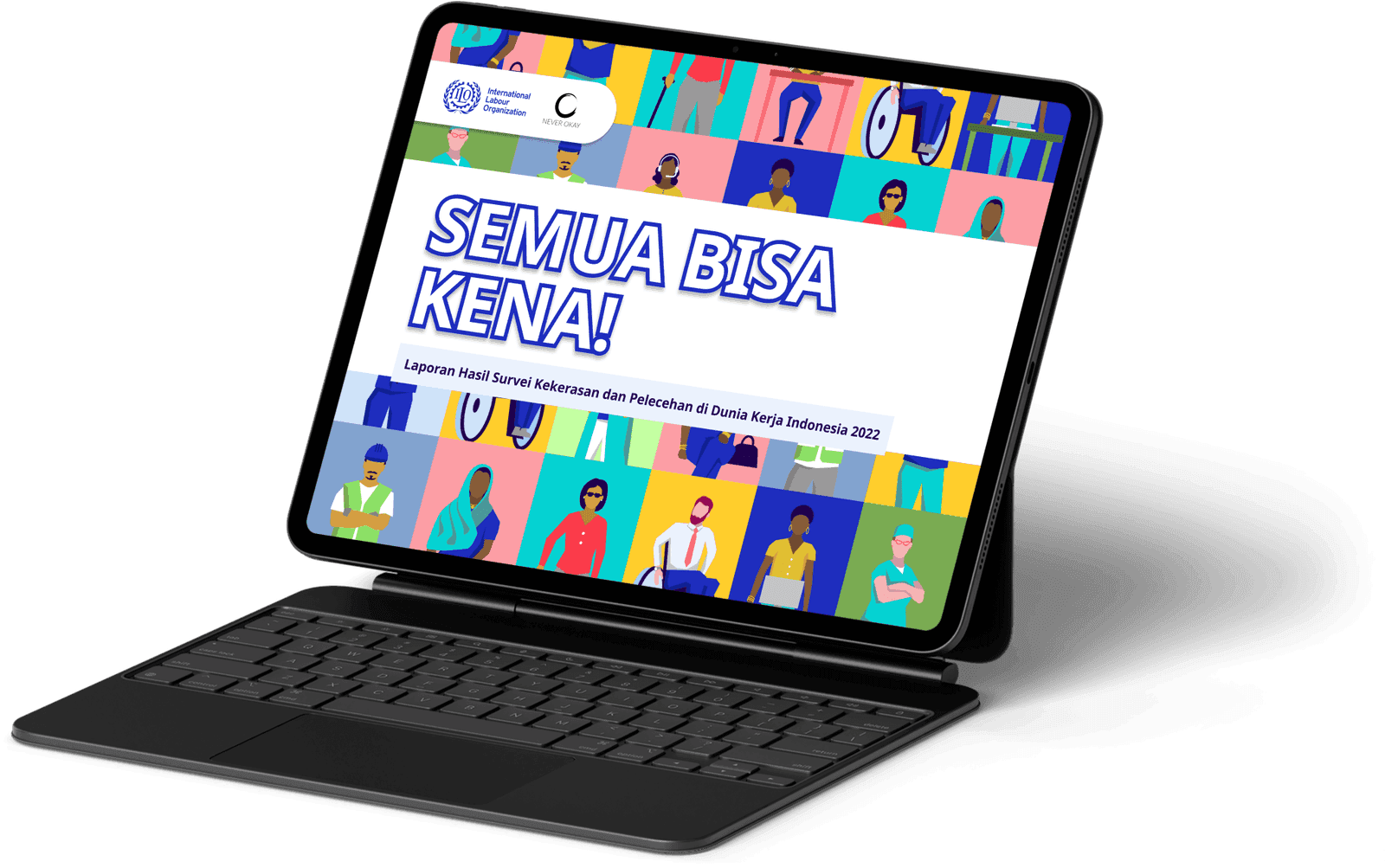
Report: Survey on Violence and Harassment in the World of Work in Indonesia 2022 by Never Okay Project & International Labour Organization Indonesia
MUST READ

Results of the 2022 survey

Report: Survey on Violence and Harassment in the World of Work in Indonesia 2022 by Never Okay Project & International Labour Organization Indonesia

MUST READ

Results of the 2022 survey

Report: Survey on Violence and Harassment in the World of Work in Indonesia 2022 by Never Okay Project & International Labour Organization Indonesia

MUST READ

Results of the 2022 survey

Report: Survey on Violence and Harassment in the World of Work in Indonesia 2022 by Never Okay Project & International Labour Organization Indonesia

© 2026 Never Okay Project. All rights reserved. Made by adila

© 2024 Never Okay Project.

All rights reserved. Made by adila

© 2026 Never Okay Project. All rights reserved. Made by adila