Activities
4
min read
Webinar: International Domestic Workers' Day 2020
Writer
Faizal Arief Firdaus
Published on
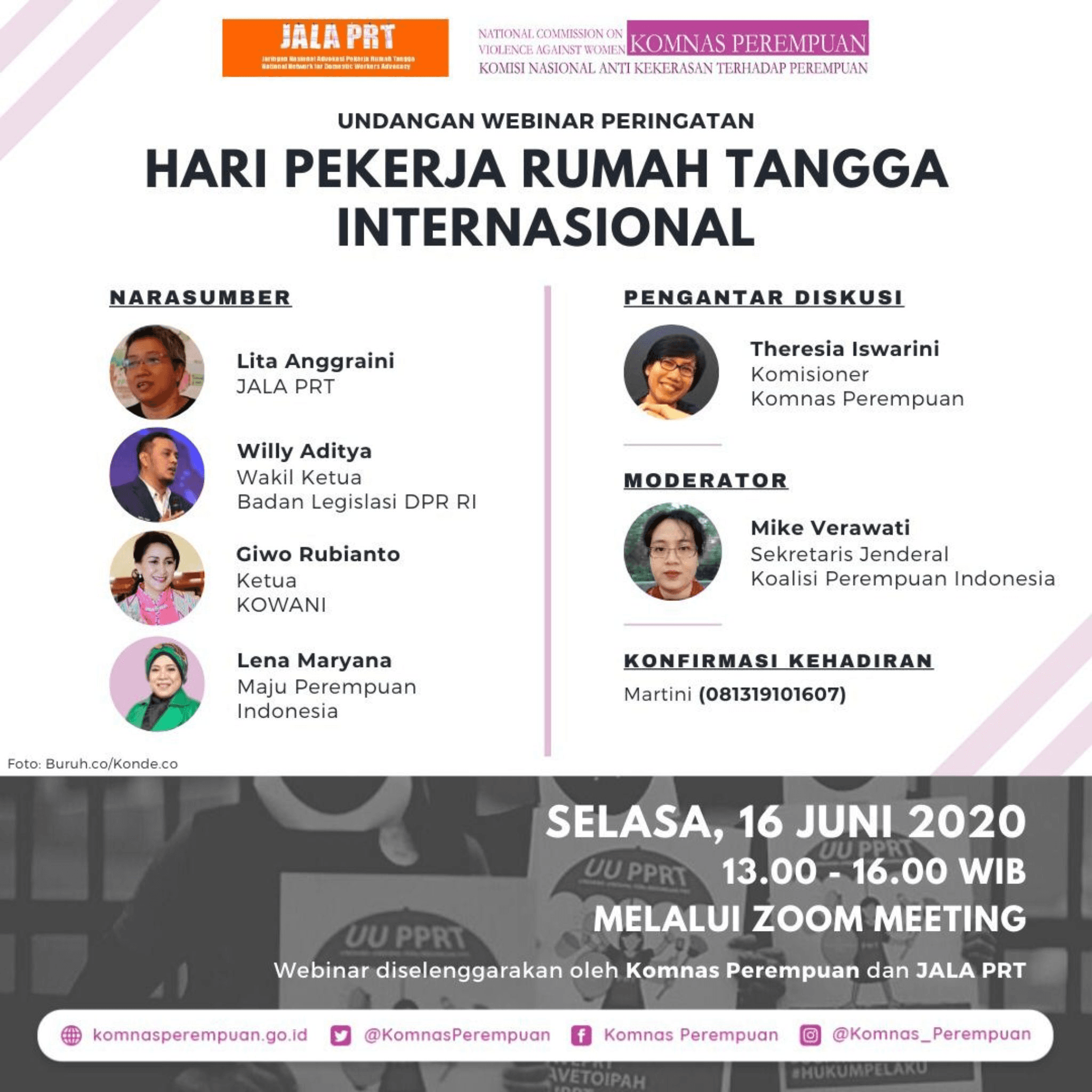
On Tuesday, June 16, 2020, it was commemorated as International Domestic Workers' Day held through a Webinar on International Domestic Workers' Day by the National Commission on Violence Against Women (KOMNAS Perempuan), the National Network for Domestic Worker Advocacy (JALA PRT), and the Indonesian Women's Congress (KOWANI). The Never Okay Project had the opportunity to attend the Webinar on International Domestic Workers' Day.
The speakers present at this webinar included Lita Anggraini from JALA PRT, Willy Aditya as the Deputy Chairman of the Legislative Body of the Indonesian House of Representatives (DPR RI), Giwo Rubianto as the General Chairman of KOWANI, and Lena Maryana from Maju Perempuan Indonesia. Theresia Iswarini as a Commissioner of Komnas Perempuan also attended and served as the facilitator of the discussion. Mike Verawati as the Secretary General of Komnas Perempuan was the moderator.
During the event, the first presentation was delivered by Giwo Rubianto, who explained that currently, Domestic Workers (PRT) need legal protection that can safeguard them, and he urged the DPR to promptly pass the Draft Law on the Protection of Domestic Workers (RUU Perlindungan PRT). Furthermore, he also stated that PRT should be recognized as a profession and not as slavery.
The DPR RI is currently processing the ratification of the Draft Law on the Protection of Domestic Workers, but as of now, the bill has not been ratified. The Draft Law on the Protection of Domestic Workers has actually existed since 16 years ago, starting in 2004, and has been a priority for the DPR since 2010-2014.
The speakers then discussed the issues of why there is still no legal protection for PRT and responded to the progress of the Draft Law on the Protection of Domestic Workers that has not yet been ratified.
PRT is an informal sector predominantly occupied by women. According to ILO estimates, there are approximately 67.1 million domestic workers worldwide, of which 11.5 million or 17.2% are migrant domestic workers. In Indonesia itself, based on data from the National Labor Force Survey (Sakernas) and the Central Statistics Agency (BPS) in 2019, more than half of the national labor force, around 70.49 million people, work in the informal sector, and 61% of them are female workers.
The most recent data collected in 2015 indicates that the number of domestic workers in Indonesia can be estimated at nearly 4 million. Meanwhile, 60-70% of the total estimate, 9 million migrant workers from Indonesia, are women working as domestic workers abroad. From this data, it can be illustrated that the protection of domestic workers is essential, as the majority of these workers are women, a group most vulnerable to various cases of sexual violence and slavery often highlighted by both international and national media. The Draft Law on the Protection of Domestic Workers has become an urgency for the Indonesian government, which ideally has specific regulations to protect these workers.
Furthermore, from Komnas Perempuan, it was explained that the issue of domestic workers in Indonesia has attracted attention from abroad. Komnas Perempuan urges the Indonesian government to promptly ratify ILO Convention 189 concerning decent work for domestic workers. Komnas Perempuan also stated that there are three International mechanisms from the UN, namely, "Universal Periodic Review" (2017), "Recommendations from the Committee on Economic, Social, and Cultural Rights of the UN", and "Recommendations from the Committee on the Elimination of Discrimination Against Women". These three mechanisms specifically encourage the Indonesian Government to pursue established decent work standards for domestic workers by ratifying ILO Convention 189 on Decent Work for Domestic Workers. The encouragement from several international communities aligns with what was conveyed by Komnas Perempuan and is consistent with the Second and Fifth Principles of Pancasila, namely "Just and Civilized Humanity" and "Social Justice for All Indonesian People" as well as the constitutional mandate of Article 28D paragraph (2) of the 1945 Constitution.
Komnas Perempuan also regrets the absence of legal protection for domestic workers. Even until now, domestic workers are often victims of violence, whether it be sexual violence, gender-based violence, domestic violence, and human trafficking. This includes the non-fulfillment of their rights as workers, such as wages, workload, leave, rest time, and capacity building.
Komnas Perempuan expresses its position in urging the Indonesian government to ratify ILO Convention 189 on Decent Work for Domestic Workers. Komnas Perempuan urges the DPR RI to ratify the Draft Law on the Protection of Domestic Workers to ensure protection and provide legal certainty to domestic workers. The presence of the Draft Law on the Protection of Domestic Workers is crucial for both domestic workers and employers to create decent work situations according to ILO Convention 189 on Decent Work for Domestic Workers.
Komnas Perempuan invites the wider community and media to support the ratification of the Draft Law on the Protection of Domestic Workers and to oversee the discussion process of the Draft Law on the Protection of Domestic Workers in the DPR RI.
The Never Okay Project also strongly supports this Draft Law on the Protection of Domestic Workers. As domestic work is a profession that holds the same rights as other workers' rights, one of which is the right to work in an environment free from sexual harassment, safe, and comfortable.
Both national and international media have extensively covered this issue. Therefore, the speakers in this webinar hope that the Indonesian government and DPR RI can soon ratify regulations that protect domestic workers and ensure their rights as workers.