Activities
3
min read
Watch NOP #7: Sexual Harassment in the Media Industry
Writer
Muhammad Firhat
Published on
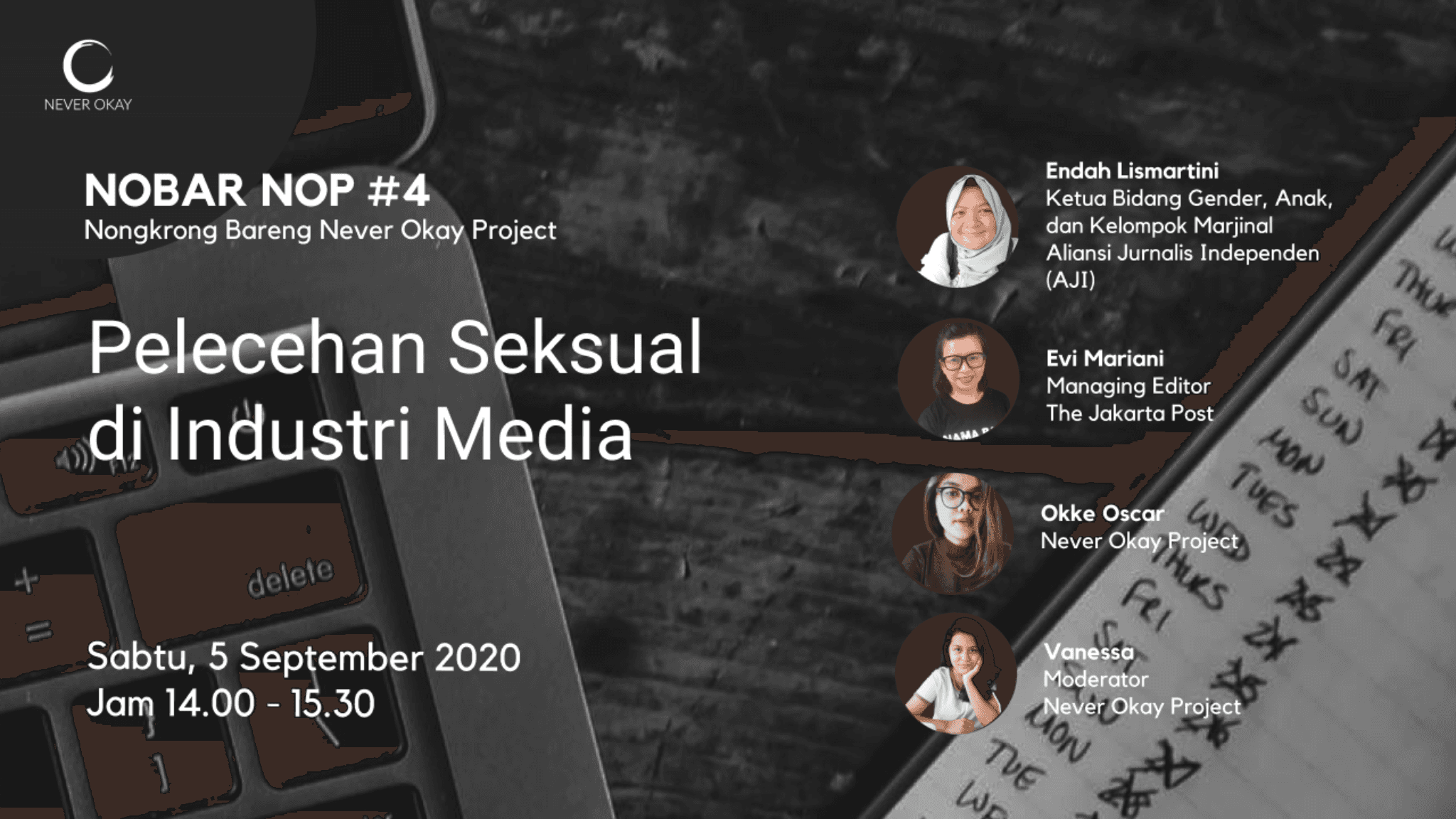
NOBAR NOP #7 (Hang Out Together Never Okay Project) is a discussion series on the topic harassment and sexual violence in the workplace. This session has the theme of Sexual Harassment in the Media Industry.
Moderated by Vanessa (Never Okay Project), NOBAR NOP #7 invites 3 speakers, namely:
Endah Lismartini – Head of Gender, Children, and Marginal Groups Indonesian Independent Journalists Alliance (AJI)
Evi Mariani – Managing Editor The Jakarta Post
Okke Oscar – Never Okay Project
Boys’ Club Culture And The Media Industry
Boys' club culture. Have you ever heard this term before? What comes to your mind when you hear or read this term? Yes. Specifically for men. Then, what about women? Evi and Endah reveal the facts that this culture is still prevalent in the media industry. This is reflected in the composition of the Press Council board for the period 2019-2022.
What, then, is the danger of this boys' club culture? Boys' club culture is closely related to patriarchy and gender inequality. Both speakers agree that this culture is detrimental to female journalists.
Beginning with various physical demands that one must possess, especially as a television media journalist, the normalization of sexist jokes occurs. Women are subordinates and sexual objects to men. This impacts the emergence of power relations among coworkers.
Read also: Survey Report on Sexual Harassment in the Workplace During WfH
Victims of Sexual Harassment and Societal Views in Indonesia
Female journalists are vulnerable to sexual harassment, supported by facts shared by the speakers. The perpetrators of sexual harassment in the media industry vary widely, ranging from sources, editors, seniors, colleagues, to law enforcement officials. Endah even shares her personal experiences regarding this matter.
According to AJI data, only a small percentage of victims are willing to pursue legal action. Various reasons underlie victims' decisions to remain silent.
An interesting point to note is the culture of victim blaming in Indonesia. This culture affects the lack of formal legal, moral, and social support for victims of sexual harassment.
Questions from law enforcement seem to corner the victims. Negative opinions from social environments towards victims and the lack of empathy from close ones also worsen the conditions of survivors. Solutions from HRD that have not yet been maximized are a topic of discussion this time.
Also check out: Letter from a Survivor: About Power Relations in the Media Industry and the Hobby of Sharing Fantasies
So, What Can We Do?
Endah revealed that out of 1800 AJI members, only 30% are women. This is evidence that the media industry is still a male-dominated industry.
Evi and Endah argue that patriarchy, gender inequality and power relations in Indonesia must be eliminated. A mutual respect between sources and journalists must be implemented. Education on gender issues among media workers needs to be enhanced.
As colleagues or close friends of survivors, Okke emphasizes the importance of moral and social support for survivors. Survivors of sexual harassment find themselves in uncomfortable situations and conditions. Feelings of embarrassment due to being belittled are prevalent. Feelings of confusion about who to turn to for help are very common.
This is exacerbated by the trauma they have to endure throughout their lives. They need someone they can rely on and trust. With that, they can rise from this unfavorable situation.
Based on World Bank data (2020), Indonesia has yet to have laws regarding sexual harassment. The Never Okay Project will continue to stand by survivors, supporting the enactment of the PKS Bill. We believe that the workplace can be free from sexual harassment.
Watch the full discussion on our YouTube channel!
References:
Batubara, H. (2018, December 1). Here Are Nine Members of the Press Council for the Period 2019–2022. detiknews. <https://news.detik.com/berita/d-4325990/ini-sembilan-anggota-dewan-pers-periode-2019-2022>
Elting, L. (2018, July 30). How To Navigate A Boys’ Club Culture. Forbes.<https://www.forbes.com/sites/lizelting/2018/07/27/how-to-navigate-a-boys-club-culture/?sh=3a80bdae4025>
Galih, B. (2018, November 8). Power Relations Considered the Main Cause of Rape. KOMPAS.com. <https://nasional.kompas.com/read/2018/11/08/18432481/relasi-kuasa-dianggap-sebagai-penyebab-utama-terjadinya-pemerkosaan?page=all>
Statista. (2021, September 9). Perception on reasons why sexual assaults happen in Indonesia 2020. <https://www.statista.com/statistics/1250314/indonesia-perception-on-causes-of-sexual-assaults/>
World Bank. (2020). Indonesia Country Gender Assessment: Investing in Opportunities for Women. © World Bank. <https://openknowledge.worldbank.org/bitstream/handle/10986/35310/Indonesia-Country-Gender-Assessment-Investing-in-Opportunities-for-Women.pdf;jsessionid=3ED657C82E2CCAC78CBE700B40D4761D?sequence=1>