Activities
5
min read
Watch NOP #10 – Emergency Sexual Harassment in the Workplace
Writer
Sasmithaningtyas Prihasti
Published on
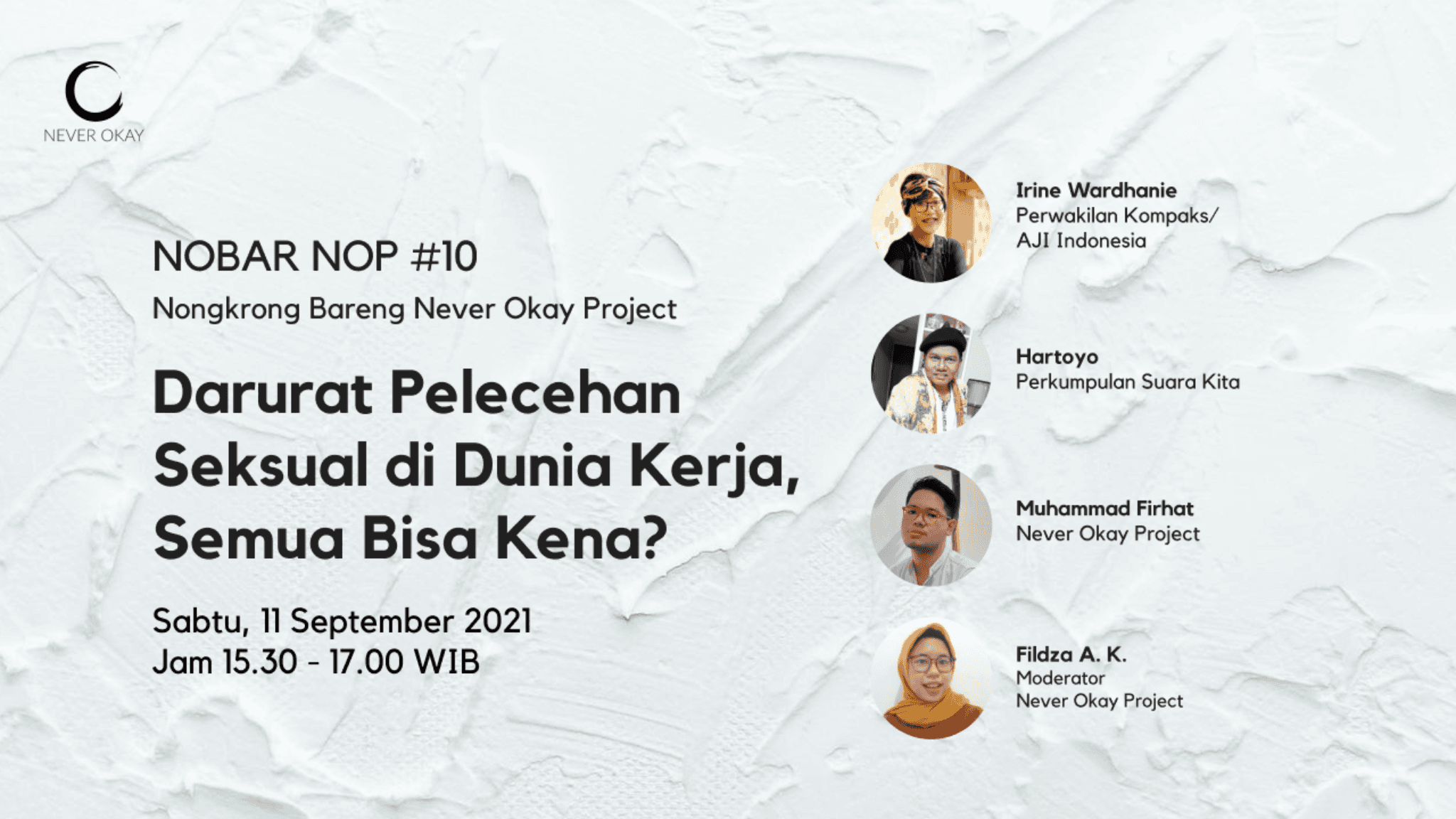
NOBAR NOP #10 (Hangout Together Never Okay Project) is a discussion series on harassment and sexual violence. This session raises the theme of Emergency Sexual Harassment in the Workplace. The lack of discussion or cases exposed by the media is the reason for bringing up this topic.
Moderated by Fildza A.K. (Never Okay Project), NOBAR NOP #10 invites 3 speakers, namely
Irine Wardhanie – Representative of Kompaks/ AJI Indonesia
Hartoyo – Suara Kita Association
Muhammad Firhat – Never Okay Project
Also read: NOBAR NOP #9: Sexual Violence Survivors Struggle to Get Justice
Sexual Harassment in the Workplace: Toxic Masculinity and Normalization
Toxic masculinity that has developed in society makes it harder for male survivors to ask for help compared to women.
Fildza explained that the stigma “how could a man be a victim of sexual harassment?” makes men afraid to share their experiences with colleagues or family. Afraid of not being believed and feeling ashamed, said Fildza.
“Ah, I was just kidding. You are the sensitive one.”
Surely you have heard reactions like the one above. It often arises when someone expresses disagreement with the treatment they have received.
In this discussion, the speakers agreed that the culture of normalizing bullying is deeply rooted in Indonesia. Hartoyo shared his personal experience in proving that the culture of bullying occurs in close environments, schools, and state institutions.
Closely related to gender stereotypes in social environments, Hartoyo revealed that there is a strong belief that bullying against feminine men is acceptable. Bullying is even considered a process of rehabilitation or improvement for these feminine men to become more masculine/macho.
All three speakers agreed that this notion must be dismantled and that there is a need for gender-neutral education among Indonesian society.
The MS Case and the Indonesian Broadcasting Commission (KPI)
Reflecting on the BPJS case in 2017/2018, Irine expressed her concerns regarding the case affecting MS. The actions taken by the KPI against MS and the content of the open letter from the victim were also discussed by Irine.
Irine argued that KPI, which is essentially a “public moral regulator,” is actually one of the least safe places for all genders (in the workplace).
Irine emphasized that complicated bureaucracy, high seniority, and the lack of clear commitment from superiors perpetuate the culture of bullying within state institutions. Many civil service employees are placed in positions that do not match the initial roles they applied for.
If they refuse, those civil servants will experience bullying or being mocked, said Irine. In turn, Firhat presented field data showing that 10 percent of acts of harassment and sexual violence occur in state institutions.
Also read: Report on Violence and Sexual Harassment Data in the Workplace 2018-2020
The Need for Ratification of Laws in Indonesia
Various forms of sexual harassment and violence in the workplace in Indonesia have not yet been accommodated in Law No. 13 of 2003 concerning Manpower. Based on this situation, Firhat expressed his views on ILO Convention 190, which could serve as a reference in ratifying the law.
ILO 190 includes definitions of the world of work and the forms of harassment and violence within it. It also explains the prevention and handling of cases of harassment and violence in the workplace.
In connection with this, Firhat also addressed the challenges in the workplace that significantly harm victims. An important point to note is the absence of a clear mechanism regarding the mitigation of cases of harassment and sexual violence in companies, impacting the treatment of victims by “ping-ponging between institutions.”
Firhat also stated the importance of strengthening a sanctions-based monitoring mechanism. This is one of the points from several recommendations for preventing and addressing cases of violence and sexual harassment in the work environment disclosed by Firhat.
Because according to him, “sexual violence in the workplace is very structural, so the handling must also be structural, where socialization, regulation, and laws must be synergistic.”
Also read: Report on Sexual Harassment Surveys in the Workplace During WfH
So, What Can Be Done to Obtain Protection from Sexual Harassment and Violence?
All three speakers agreed that in efforts to obtain protection from sexual harassment and violence, we cannot wait until the law is ratified or the bill is passed. Hartoyo added that this can start with the establishment of SOPs for prevention, handling, and sanctions related to gender-based and sexual violence in state institutions.
Firhat also revealed that it is essential for workers to actively urge companies to build initiatives against violence and sexual harassment.
Moreover, Fildza highlighted the importance of socializing Ministerial Regulation No.1 of 2000 concerning the Protection of Women Workers.
Why? Because it includes types of violence in the workplace. Forms of discrimination in the workplace. And the mechanisms that companies must implement if harassment and sexual violence occur in their work environment.
It should be noted that only 6 industrial sectors have implemented this, said Fildza. Even no state institutions have implemented this regulation.
All three speakers also reminded that it is essential to understand the needs of victims. To what extent are victims willing to be assisted in fighting for their rights to obtain justice? It should also be noted that there is a long and exhausting process that victims must go through when they agree to go the legal route.
Never Okay Project, alongside other communities, is currently and will continue to support legal reforms to become stronger. We believe that both women and men have the right to legal protection from acts of harassment and sexual violence.
Watch the full discussion on our YouTube channel, okay!
References:
Admin Team. (2015, August 24). Gender stereotypes. Indonesian Women's Coalition. Accessed on November 7, 2021, via <https://www.koalisiperempuan.or.id/2011/05/04/stereotip-gender/>.
Babyologist Team. (2019, April 11). Gender Equality in Child Rearing. kumparan. Accessed on November 7, 2021, via <https://kumparan.com/babyologist/kesetaraan-gender-dalam-pengasuhan-anak-1qrrcrRCKUH/4>.
Salam, M. (2019, January 22). What is toxic masculinity? The New York Times. Accessed on November 7, 2021, via <https://www.nytimes.com/2019/01/22/us/toxic-masculinity.html>.