Photo Journey
12
min read
Daniel Baskara Putra
Writer
NEVEROKAY
Published on
“When you hold the mic, you have the power to make the environment better”
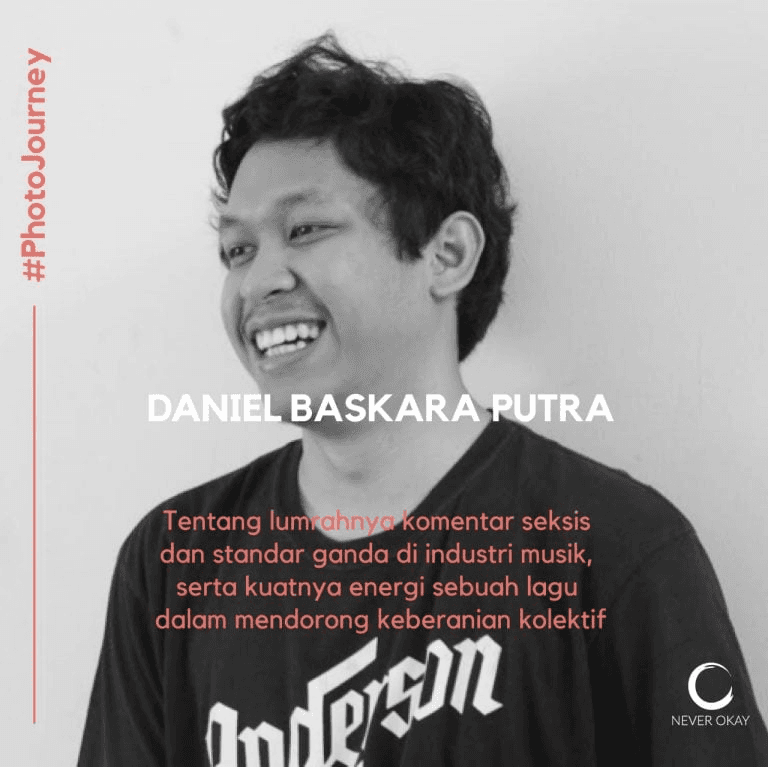
Baskara Putra, known by his stage name Hindia, is a man born on February 22, 1994. At the age of 25, Baskara is considered successful as a national musician who has produced hit singles played on major radio stations. Not to mention the music he created with his college friends in a band called .Feast; it's certain that young people (and often older ones, like the writer's father) who enjoy the rock genre must be familiar with the songs “Civilization” and “News of Loss,” inspired by the bombings in Surabaya. Some time ago, the Never Okay Project team, represented by Fiana and Imel, had the opportunity to talk with Baskara. Starting from gender equality, women's empowerment, and of course, sexual harassment in the music industry from a man's perspective, particularly, from the perspective of Baskara Putra.
Having previously worked at the British Council, as a Brand Manager at Double Deer, and as the Founding Father and CEO of Bagikata, Baskara certainly considers himself a worker. When we read about the conditions of workers, especially female workers in Indonesia, Baskara was shocked to find that 43% of Indonesian female workers are able to reach senior management levels in companies—this is the second highest figure in the world (Women in Business 2018). A small achievement to be proud of, he believes. It turns out that Baskara's shock is based on stories from his colleagues who work in the U.S. and experience discrimination, especially in the creative industry. Remarks like “I don't want a female director!” have been heard by his colleagues who work there.
Gender Equality Through Baskara's Lens
Baskara went to a homogeneous high school that instilled values of equality. He realized this during college when he encountered gender studies courses; looking back at his high school days, he recognized that his school had already instilled values of equality. The decrease in values from his seniors took the form of little things, such as not being allowed to do anything disrespectful to women.
Baskara never expected that his homogeneous school would not make him sexist. And during his time at college, FISIP UI was already progressive in terms of equality. He gives the example of Fiana, who happened to be interviewing Baskara as an example. Fiana was Baskara's coordinator in a division in the committee while he was studying at FISIP UI. A division that is known to be difficult to lead by a woman. However, Baskara mentioned that Fiana was able to lead that division well and successfully, regardless of any stigma. Besides Fiana, many other divisions have also begun to be led by women.
Baskara himself has grown up with the view that women are suited to lead. However, he laments that many of his friends and people out there do not share his opinion, especially in the music industry, he emphasized. To this day, he still hears remarks like, “Seriously, your sound engineer is a girl?” When faced with such situations, Baskara always positions himself to correct that question by asking what the difference would be if the sound engineer were male. He flips the question by asking whether men can hear higher frequencies than women, or if women only have 8 fingers, so they can't operate the control board. Currently, Baskara's sound engineer mentioned that there are many women in his alma mater who are taking programs in Sound Engineering, Sound Design, and other fields that are usually dominated by men.
“Nowadays the world is more progressive”, said Baskara. If we look outward, even in the global industry, the producers of big talents are women. And what cannot be denied is that if a job typically done by one gender is done by the opposite gender, it will bring a new perspective in that field. Because there are personal experiences that cannot be obtained as a man or woman, or vice versa. Baskara is very grateful to have grown up in an open-minded and non-conservative environment. Because, in his opinion, there is still a lot of conservatism.
Women Who Inspire Baskara
When discussing women who inspire Baskara, he immediately mentions the full name of the General Manager of .feast “Rifanda Putri” and manager of Hindia “Melina Anggraini”.
When Baskara first formed .feast while studying at FISIP UI, he never said that .feast was a rock band. However, it cannot be denied that .feast has a very hard image and often receives severe criticism. There are often humorous remarks that the members of .feast are police operation targets. Bringing such a hard image from the time .feast was still in college, Rifanda successfully brought .feast to where it is now. This year marks the 7th year of Feast, and Rifanda has proven that she can perform better than men. Baskara says, “what Panda (Rifanda) does for .feast, what Anggra (Melina Anggraini) does for Hindia and .feast, not just anyone can do, and this has nothing to do with gender. If you can, then you can, why should it be differentiated?”
In addition to being the manager of Hindia, Anggra is also a Stage Photographer. Baskara expresses that he rarely sees female stage photographers, while .feast is a band whose image is built by Visual Live Photography. Anggra has managed to build .feast's image to the point where she is highly respected in her field. For Baskara, a man given the responsibility to manage five other men is difficult. However, Panda and Anggra can manage .feast, which consists of five young men with diverse personalities.
Baskara once heard a saying, “he is not suitable to be managed by a female manager.” Instantly, Baskara asked “why? My band can do it, my band has reached a national level managed by a woman from the start.” According to Baskara, Panda not only breaks stereotypes by managing a band with such a masculine image, but she also breaks the notion that a hijab-wearing woman can manage a band like .feast. Together with Anggra, Panda has successfully strengthened the relationships between the personnel, crew, and other parties involved in .feast and Hindia. Baskara himself tries to always defend Panda when her or Anggra’s credibility in their work is questioned by others.
According to Baskara, there is a significant difference between a boss and a leader. If the boss is a title, then the people being led follow his wishes out of fear. Panda and Anggra, in Baskara’s eyes, are team leaders. If there are things that all parties do not agree upon, Panda will open a discussion, even to the point of debate, but Panda can direct the debate toward the best solution. Baskara assesses that Panda can successfully fulfill her duties in an industry where people say this work can only be done by men. Baskara also says that he rarely finds a female general manager managing a band with a genre like .feast, which obviously consists entirely of male members. Likewise with the Feast listeners; they know well who Panda is. And for the listeners of .feast and Hindia, Panda and Anggra are their leaders. Panda and Anggra bring a different perspective to .feast compared to the five personnel.
.feast with its loud music, Baskara emphasizes that he does not groom toxic masculinity in his music. For Baskara, music in .feast and how it is groomed can make him a fan of Troye Sivan, who is homosexual, yet according to Baskara, Troye Sivan is more masculine than some other men.
Sexual Harassment in the Workplace
Baskara is grateful he never worked in a sexist environment before fully entering the music industry. However, after hearing the Never Okay Project survey results that 94% of respondents reported experiencing sexual harassment in the workplace, he began to doubt his understanding all this time. What Baskara fears is that this phenomenon occurs in the environment where he previously worked, but he did not realize it. Baskara stated that this unawareness could be because he is a man, and therefore the lack of sensitivity to the phenomenon could happen. He argues that it is not impossible because of the strong power relations making the phenomena unheard by him, as it has been suppressed by more powerful forces.
A few months ago, Baskara released a single titled
Other articles

Article
3
min read
Being Competent vs Being Liked. Why are female leaders always forced to choose?
"She's too emotional."
"She's too nice to lead."
Comments like these might sound simple. However, behind them lies a double standard that still affects how we view leadership in the workplace. In various organizations, female leaders are still faced with conflicting expectations. When women are firm and assertive, they risk being labeled bossy or emotional. But when women show empathy and warmth, their competence is questioned instead.
In Enemies with Benefits, the character Wine, who is newly appointed as a Supervisor, is immediately labeled "just a pretty face" due to her friendliness at work. To gain respect from her team, Wine feels she must change her demeanor and suppress her personality to appear more "worthy" of being a leader.
Wine's experience reflects a phenomenon known as the likability-competence trap.
A bias that often forces women to choose between being respected for their competence or liked for their personality. This double standard means that a female leader's competence is judged not only by her work results, but also by the way she speaks, expresses emotions, and builds relationships.
“women who lead are disliked, and women who are liked don’t lead.”
This kind of bias rarely presents itself in the form of overt discrimination. Instead, it arises through everyday comments, feedback, performance reviews, and promotion processes that appear objective, yet are still influenced by unconscious gender stereotypes (unconscious bias).
Consequently, a woman's leadership is often judged not just by things that objectively support work success, such as the quality of decisions, work results, or the impact created. Instead, assessments are also influenced by the extent to which a female leader is considered "friendly" enough, "assertive," "pleasant," or aligned with gender expectations that still linger in the workplace.
For organizations, the impact is not only felt by individuals. Bias in evaluating leadership can limit the diversity of leadership styles, hinder creativity and human resource development, and make decision-making processes less fair.

Image: A scene of Wine crying upon hearing gossip from her coworkers about her.
Building an inclusive workplace is not just about opening up more opportunities for women or vulnerable groups to lead. What is equally important is ensuring that every process of evaluation, promotion, and feedback is conducted with fair standards. Inclusive leadership begins when competence becomes the basis of evaluation, not stereotypes about how a leader "should" behave.
Focus on competence.
Focus on work results, objective KPIs, leadership quality, and impact, rather than whether someone seems “friendly enough” or “assertive enough” in their interactions.
Distinguish leadership style from leadership ability.
Not all leaders have to show the same style to be effective. Diverse leadership styles can support the growth of creativity in the work culture and in decision-making. Support women to lead authentically.
Review the language in performance reviews.
Avoid feedback that focuses on someone's personality or expression, such as being "too emotional", "lacking warmth", or "lacking authority". Provide specific, work-behavior-based, and actionable feedback.
Be aware of bias before making decisions.
Reflect on whether evaluations, promotions, or feedback are truly based on performance, unaffected by unconscious gender stereotypes (unconscious bias).
Because in the end, competence has no gender.
An equal workplace is a place where everyone can lead authentically, without the need to suppress themselves to gain respect. Have we truly evaluated and appreciated leaders based on their competence, integrity, and the impact they create?
Read more

Article
4
min read
Creating Proactive Mechanisms for Handling Sexual Harassment: Learning from Filing for A Love
“At our office, we are safe; after all, there has never been any report received so far.”
The above statement cannot be used as a foundation to validate the absence of handling mechanisms for sexual harassment and violence in a company or institution.
For many corporate managements, the absence of reports is often used as an indicator that their work environment is completely clean and safe. However, the reality is not that simple. The absence of reports does not mean there are no cases at all. Regulatory documents must still be possessed and actively implemented, even if there has never been a report of violations.
The Danger of Not Having Clear Mechanisms
Based on data released by the Never Okay Project in 2022, many workplaces still do not have clear mechanisms to handle cases of sexual violence and harassment.
As many as 34.53% of respondents mentioned that their workplaces do not have mechanisms against sexual violence and harassment. Meanwhile, another 23.53% of respondents did not even know whether their office already has such handling mechanisms or not.
This is dangerous. Ignorance and the absence of clear mechanisms will make many victims and witnesses choose to remain silent. Because they do not know where to report and receive handling.
Learning from the Haemu Audit Team
The K-drama Filing for Love, in episode 4, tells the story of Lim Ha-Kyong (a junior engineer) who experienced sexual harassment and intimidation by James (the director). The victim felt pressured and chose not to report her situation when asked by Jo In-A (the Leader of the Haemu Audit Team).
Even though the victim claimed "nothing happened," In-A still conducted an investigation according to the applicable protocols and policies. The process was carried out without compromising the victim's position.
In-A's brave decision enabled the existing policies to be executed effectively. Evidence was successfully gathered, the perpetrator was punished, and the victim was slowly able to recover and return to work.
This story aims to show that active intervention from the company is proven to be able to save victims while maintaining organizational integrity.
Why a Proactive Mechanism is Important
Providing a responsive protection system is not just a form of care for staff, but a strategic investment for business continuity. The benefits for the company are not small
Creating psychological safety. This means employees can work peacefully without being overwhelmed by anxiety about their safety.
Increasing employee and team productivity. A healthy work environment, free from intimidation, of course, has a positive impact on work performance.
Building a healthy and sustainable work culture. This is possible due to deeply rooted values of professionalism and mutual respect within the company ecosystem.
Maintaining and enhancing business reputation. Doing business in the digital era makes companies that are committed to humanitarian issues highly attractive (employer branding) in the eyes of job applicants and investors.
Mitigating management crisis and public relations (PR) risks. Having internal handling SOPs prevents cases from escalating into public scandals, while also fostering public trust in the company's handling.
Two-Way Synergy to Create a Proactive and Effective Mechanism
A mechanism, no matter how good, cannot run effectively if its implementers are confused and intimidated.
Adapting the global guidelines from the International Labour Organization (ILO), here are the things companies can do to create proactive and effective mechanisms against sexual violence and harassment.
From the policy perspective:
Strictly defining what constitutes clear sexual harassment and violence in the workplace.
Declaring a zero-tolerance stance against all forms of sexual violence and harassment.Guaranteeing a clear, confidential, and safe reporting mechanism for reporters.
Having investigation SOPs that side with the victim's rights (a victim-centered approach).
Requiring periodic risk assessments to mitigate potential violations.
From the HR readiness perspective:
Holding mandatory training related to anti-harassment policies for all levels of employees.
Forming a special team for handling cases and providing them with specialized training (as demonstrated by Jo In-A and her Audit Team).
Providing specialized training for managers, supervisors, and team leaders to be sensitive in detecting issues.
Guaranteeing access to dedicated, easy-to-use channels for reporting.
Thorough, transparent, and justice-oriented handling of harassment cases has been proven to rebuild employees' trust in the company's credibility.
The first step to breaking the chain of workplace sexual violence begins when management dares to open its eyes, draft strict regulations, and train its HR to be proactive protective guards.
Read more

Article
3
min read
There Are No Hacks for Female Leaders
Deborah Vance in the series Hacks is the character of a female comedian who has been successful for the last three decades of her career. As a leader and employer, Vance is far from ideal. The fast-paced and sometimes toxic work culture in the entertainment industry does not make things any better. A familiar pattern emerged when Vance dared to dream even bigger. She was then deemed too ambitious. Conversely, Vance does not easily show her vulnerable side to the team she leads, so as not to be labeled weak. Vance's career journey serves as a reminder of familiar challenges. Many of us subconsciously question women in leadership positions.
Psychologist Madeline Heilman from New York University developed a framework she calls the "lack of fit model." According to this model, first introduced in 1983, discrimination against women stems from a perceived mismatch between the attributes women are thought to possess and the attributes believed to be necessary for success, especially in male-dominated positions and fields. In other words, women are considered unfit for leadership roles because gender stereotypes conflict with leadership stereotypes. Gender stereotypes generally cast men as leaders (take charge) and women as responsible for caregiving (take care). For example, men are expected to be strong, decisive, and assertive. Women are viewed as nurturing, emotional, and communicative.
In Heilman's follow-up study involving 242 participants across 3 different experiments, it was found that when women were acknowledged as successful in traditionally male-dominated occupations, they were rated as less likable. Women also received significantly more personal derogatory comments than men who achieved identical success.
This phenomenon was later summarized by the Catalyst organization in their 2007 report under the term "double bind," meaning female leaders are caught in a situation where they lose on both sides. Damned If You Do, Doomed If You Don't. When women are strong, decisive, and assertive, they are viewed as competent but disliked. When women are nurturing, emotional, and communicative, they are liked but viewed as less competent leaders.
The most frequently offered solution is to increase the number of women, especially in leadership positions. But sociologist Rosabeth Moss Kanter had already warned about the limitations of this solution since 1977. In research conducted at a Fortune 500 company, Kanter categorized women who were a minority of under 15% in a work group as "tokens." Tokens experience specific pressures due to the skewed proportions, such as:
Over-visibility: every action and mistake they make is noticed and scrutinized more, because they are seen as representing their entire group.
Assimilation: they are encouraged to conform to roles that are already familiar to the majority, rather than being expected to bring new ways of leading.
Contrast and role-traps: they are guided to fit into pre-existing stereotypes for women rather than being viewed purely as leaders.
In the workplace, the double bind phenomenon ensures that evaluations of female leaders are skewed from the very start, regardless of the leadership style chosen. Tokenism ensures their presence at the top remains merely symbolic, without any deep-rooted systemic change. This change, of course, cannot be expected to happen overnight. However, there are some small strategies that can be practiced in daily life starting now:
Interrupt bias
Speak up if there is a situation that perpetuates negative gender stereotypes.
Example: if someone says "she is so emotional" when a woman is speaking, try to redirect the focus to the substance of her speech.
Use the same standards
Challenge your thinking by swapping a person's gender to see if there is a difference in the standards you apply.
Example: before asking a female colleague how she manages to have career ambition and take care of a family, check with yourself whether you would ask a male counterpart the same thing.
Understand specific challenges
Instead of placing female leaders as tokens, strive to be more sensitive to the barriers they face and what can be gradually changed to ensure more female leaders are empowered.
Example: in meetings, observe whether ideas from women are frequently interrupted, repeated by others and only then considered valid, or given less airtime compared to male colleagues. If so, actively redirect the credit back to the original idea owner.
Deborah Vance is not a perfect character or leader. So what? Imperfect male leaders are generally given the space to grow, fail, and try again. Imperfect female leaders are more often questioned whether they should have been in that position in the first place. Let's start shifting old habits. If someone has leadership shortcomings, the focus should be on those specific areas, rather than passing judgment based on gender and gender stereotypes.
Read more