Research
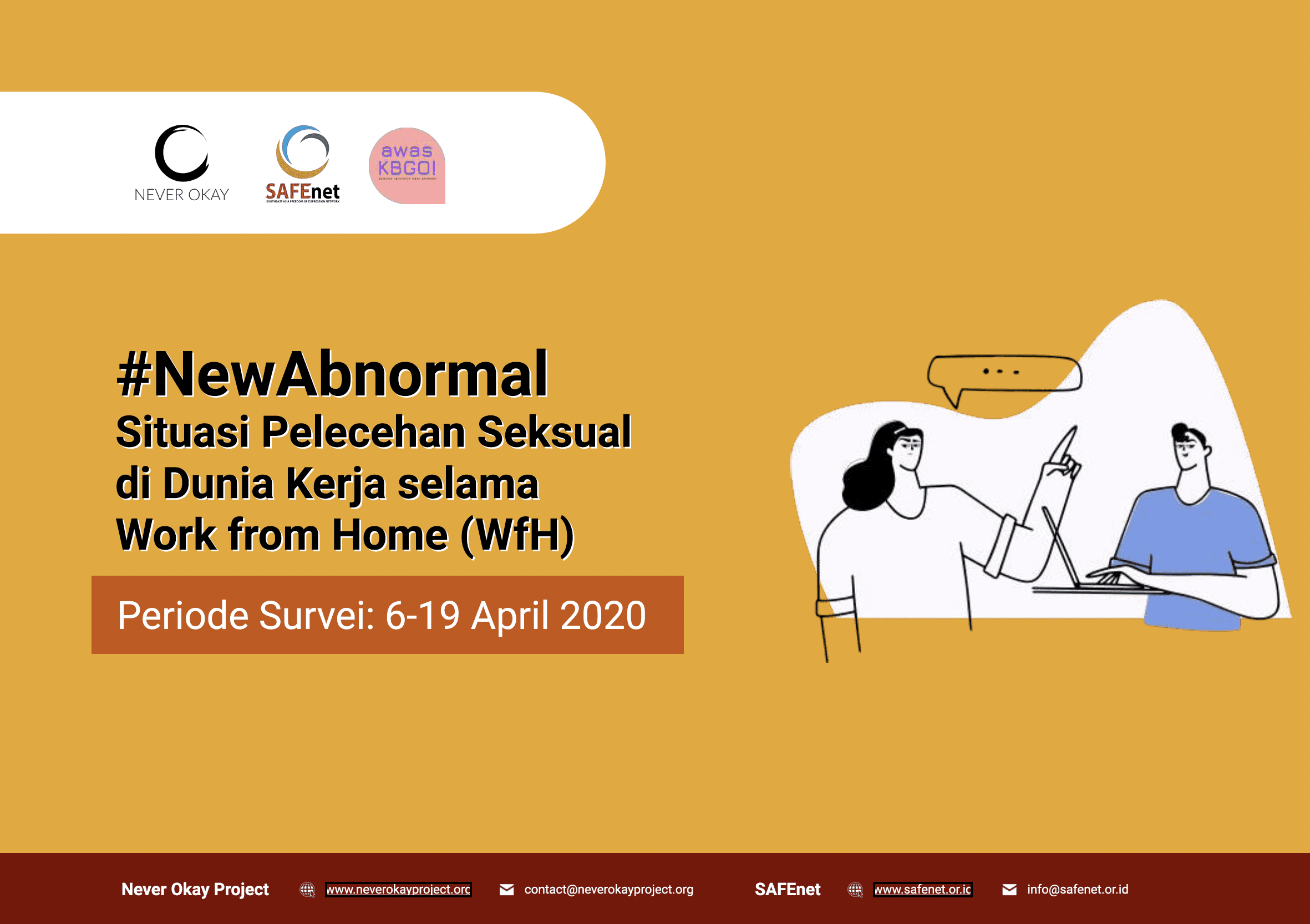
The Never Okay Project and Southeast Asia Freedom of Expression (SAFEnet) found the risk of sexual harassment occurring while working from home during the Covid-19 pandemic. This finding is revealed in a survey publication titled #NewAbnormal: The Situation of Sexual Harassment in the Workplace during Work from Home (WfH).
The Covid-19 pandemic has impacted many aspects, including the work environment. This forced most industries to change their working conditions and systems that were usually conducted face-to-face in the office to be replaced by remote work using digital communication technology. Unfortunately, this change in the work system was not accompanied by instruments to prevent sexual harassment. This has created and increased the risk and patterns of sexual harassment practices through digital technology among workers.
From an online survey conducted from April 6 to April 19, 2020, with 315 respondents working from home, it was revealed that 86 of them were victims of sexual harassment during WfH, 68 respondents reported witnessing sexual harassment, and 30 respondents had been both victims and witnesses of sexual harassment.
“The risk of sexual harassment while working from home remains high because it is not supported by instruments of workplace safety, in this case, anti-sexual harassment policies. From our survey, 85% of companies still do not have sexual harassment policies during WfH,” said Never Okay Project Initiator Alvin Nicola.
“This is evidenced by the survey findings.” Alvin noted, “The majority of victims do not report to HRD. There are 94% of victims who do not trust HRD to advocate for and protect them, and 38% feel HRD will not do anything. Some are also worried that their careers will be affected, afraid that no one will believe them, to fearing being blamed or facing victim blaming.”
Alvin also explained that not only women are victims of sexual harassment. The survey revealed that all gender identities can become victims of sexual harassment while working from home.
The survey results also indicate that workplace relationships within companies affect an individual’s vulnerability to experiencing sexual harassment. Alvin mentioned that the majority of victims are in contractual, internship, or staff employment relationships, while on the other hand, no entrepreneurs were found to have ever been victims.
This survey also found that the sexual harassment experienced by workers occurs across digital platforms used for work with a substantial frequency. As many as 78% of victims had experienced harassment on 2 to 7 communication technologies simultaneously within 1 month of working from home.
Ellen Kusuma from Digital At-Risks, SAFEnet disclosed that messaging applications, such as WhatsApp, Line, Telegram, and others, are the channels most frequently used by perpetrators to commit sexual harassment (40%), followed by social media applications (19%), video conferencing applications (16%), internal company applications (10%), email (7%), phone (5%), and SMS (3%).
“In the workplace, digital and online communication technologies, such as video conferencing and messaging applications, are generally used for group work or many people simultaneously. If these technologies become the places where the most sexual harassment is experienced by workers, it means that the culture of normalization or the acceptance of forms of harassment is still very strong, even in group communication, which consists of colleagues.”
“This should not be allowed to continue, perpetuated as a ‘new normal’ situation going forward,” she added, “This is a ‘new abnormal’ situation.”
Furthermore, Ellen stated that this survey also found 9 forms of sexual harassment experienced by victims. “Among them are in the form of sexual jokes or humor, or sent multimedia content, such as photos, videos, audio, text messages, or stickers that have sexual overtones non-consensually. Furthermore, all these incidents can occur across multiple platforms. We found that 78% of victims had experienced sexual harassment on more than two platforms.”
Based on these findings, the Never Okay Project and SAFEnet provide several recommendations, namely to:
The Ministry of Manpower is urged to immediately commit to ratifying ILO Convention No. 190 of 2019 and Recommendation No. 206 on Violence and Harassment in the World of Work to ensure workers receive a guarantee of protection from sexual harassment practices, especially for female workers. This ratification is increasingly urgent because until now, Law No. 13/2003 on Manpower and the Job Creation Bill in the Labor cluster do not regulate violence and sexual harassment in the workplace.
Companies should immediately design various initiatives and anti-sexual harassment strategies, especially for situations of working from home, such as initiating education on the risks of sexual harassment, building policies that are victim-centered, strengthening oversight mechanisms based on sanctions, and designing impartial reporting systems and mechanisms for cases. In particular, companies need to review the risks of sexual harassment within their internal structures and pay close attention to online-based sexual harassment.
Labor unions or trade unions should encourage the establishment of a tripartite mechanism involving state institutions, companies, and labor unions to ensure the safety and security of workers working from home, particularly from the risk of sexual harassment practices. Labor Unions/Trade Unions also need to initiate a reporting mechanism for sexual harassment cases that favors victims.
Workers should urge companies to build anti-sexual harassment initiatives and build solidarity by rejecting the normalization of harassment culture. Workers can also strategically form coalitions of allies for victims and active witnesses by identifying risks of sexual harassment while working from home.
The complete survey results can be downloaded at
Jakarta, June 12, 2020
Never Okay Project and SAFEnet
About the Organizers
Never Okay Project
The first mission-based initiative in Indonesia that supports communities and institutions in creating a work environment free from sexual harassment.
Contact: Instagram @neverokayproject | e: contact@neverokayproject.org | w: neverokayproject.org
SAFEnet/Southeast Asia Freedom of Expression Network
A non-profit organization established on June 27, 2013, in Bali, Indonesia, advocates for digital rights as part of human rights in Southeast Asia, including the Right to Feel Safe. Be Cautious of KBGO! is SAFEnet's initiative to thoroughly address issues of online gender-based violence.
Contact: Instagram @safenetvoice @awaskbgo | s.id/contactSAFEnet | w: safenet.or.id
Writer
Never Okay Project x SAFEnet
Published on